Sound Proof Enclosures Manufacturer in India
Summary: Sound proof enclosures are engineered, sealed structures built around noisy machines, compressors, generators, sewing machines, hydraulic power packs, blowers, and turbines, to cut noise by 25 to 50 dB(A) using dense composite panels, sound absorbing infill, and tuned ventilation. This page is written for plant heads, EHS officers, procurement teams, and OEM equipment integrators in India who need to specify, compare, or troubleshoot sound proof enclosures before ordering.
Is This Sound Proof Enclosures Guide Right for You?
Who It's For
Manufacturing plants, textile and garment units, compressor and generator installers, testing labs, and OEMs supplying machinery that exceeds workplace noise limits.
When to Use This Guide
Before finalising a vendor, while comparing STC specs across quotes, or when an existing enclosure isn't holding its rated noise reduction.
Proven Track Record
Ecotone Systems is an ISO 9001:2015 certified enclosure manufacturer with 40+ years of engineering experience and enclosures tested to CSIR National Physical Laboratory (NPL) standards, India's national metrology institute for acoustic testing.
What Is a Sound Proof Enclosure?
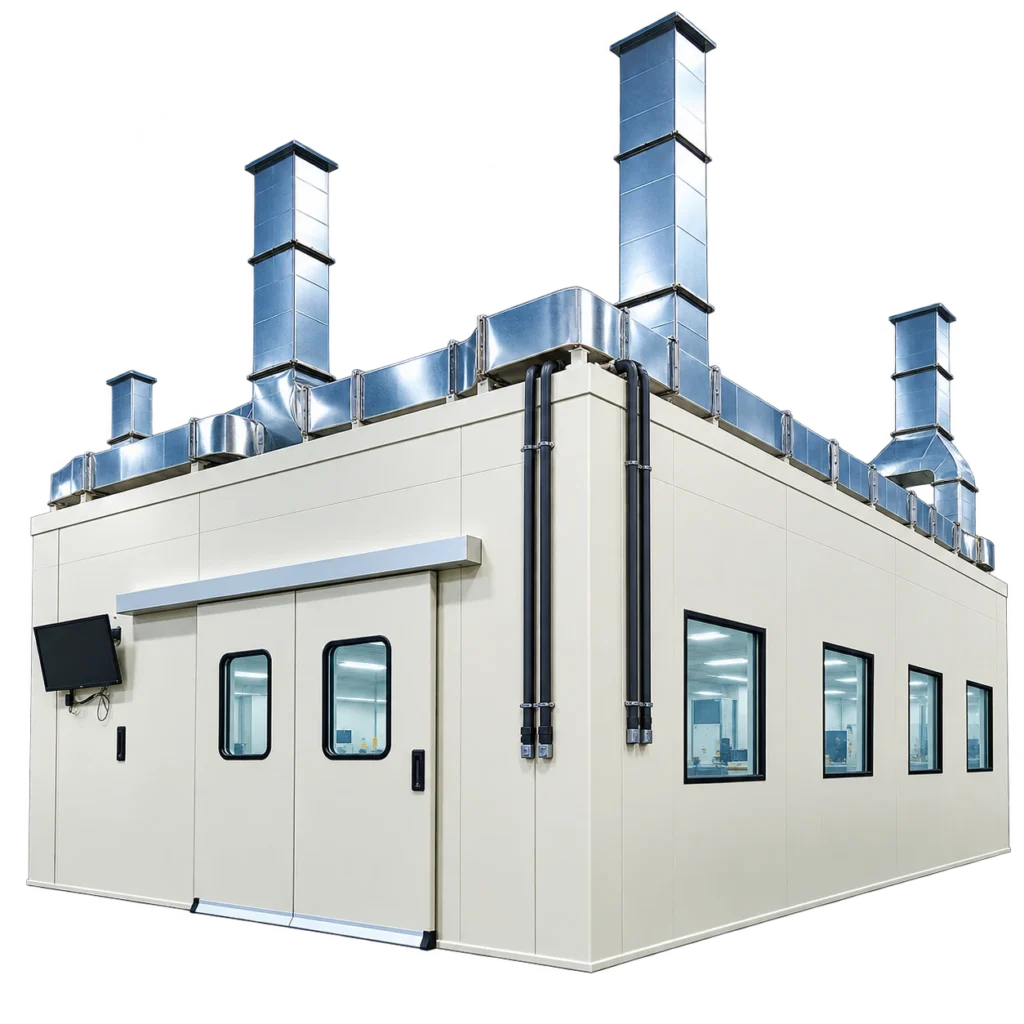
A sound proof enclosure, also called an acoustic enclosure or industrial sound enclosure, is a factory-built box or room made from dense, layered panels that surrounds a noisy machine to stop sound from radiating into the surrounding workspace. It works by combining a sound absorbing inner layer, usually mineral wool or acoustic foam, with a heavy outer skin that reflects sound waves rather than letting them pass through. Unlike a simple metal cover or plywood box, a properly engineered enclosure is tested for its Sound Transmission Class (STC) rating and includes ventilation designed specifically so the enclosed machine does not overheat. If you came here to understand the term in one sentence, that is it. The sections below cover how to pick the right one for your machine.
Why Indian Manufacturers Are Switching to Certified Sound Proof Enclosures
Machinery noise is one of the most common compliance gaps flagged during factory inspections in India, and it is also one of the most misunderstood. OSHA-aligned occupational exposure guidance treats continuous noise above 85 dB(A) as a hearing hazard requiring engineering controls rather than PPE alone. Many Indian units still rely on plywood boxes, loose foam sheets, or fabricator-built covers that were never acoustically tested, and these typically underperform their claimed noise reduction by a wide margin once ventilation openings and acoustic doors are added. This is why procurement teams are now asking sound proof enclosures manufacturers for an actual test report referencing a recognised lab such as CSIR NPL, rather than accepting a spec sheet number at face value. This guide explains exactly what to check before you sign a purchase order.
Specifications, Benefits, Applications & Installation Process
| Parameter | Standard Specification |
|---|---|
| Panel construction | Double-skin CRCA or GI sheet, 16-gauge |
| Infill material | Mineral wool or acoustic foam, fire rated |
| STC rating range | STC-40 to STC-60 |
| Frequency coverage | Full octave band, 63 Hz to 8 kHz |
| Finish | Epoxy or powder coating, client colour choice |
| Ventilation | Acoustic louvers with insulated ducting |
| Build type | Water resistant, dust and humidity protected |
| Benefit | Impact |
|---|---|
| Noise compliance | Meets factory-act and OSHA-aligned exposure limits |
| Hearing protection | Reduces continuous worker exposure below 85 dB(A) |
| Equipment protection | Shields machines from dust, weather, humidity |
| Fire safety | Fire rated infill reduces combustion risk |
| Uptime | Ventilated design prevents heat related shutdowns |
| Workplace comfort | Cuts reverberation for nearby workstations |
| Resale value | Enclosed equipment shows less wear over time |
| Application | Typical Machine or Industry |
|---|---|
| Compressor enclosure | Air compressors in manufacturing and pharma |
| Generator enclosure | DG sets in power backup installations |
| Sewing machine enclosure | Garment and textile units |
| Hydraulic power pack enclosure | Fragrance, chemical, and process plants |
| Turbine and blower enclosure | Power plants and process industries |
| Punch press enclosure | Auto components and metal fabrication |
| Control room enclosure | Operator cabins near loud machinery |
Sound proof enclosures also extend into related noise control installations Ecotone delivers on the same sites, including dynamometer test enclosures , NVH test chambers , anechoic chambers , and large-scale industrial noise barriers for sites that need both machine-level and boundary-level noise control in one project.
| Step | Action |
|---|---|
| 1. Site assessment | Measure ambient dB(A), machine size, heat output |
| 2. STC and design selection | Match panel STC to required noise reduction target |
| 3. Fabrication | Panels pressed, infilled, and coated at factory |
| 4. Foundation and layout prep | Base leveling, cable and duct routing on site |
| 5. Panel assembly | Bolted or cam-lock erection with gasket sealing |
| 6. Ventilation integration | Acoustic louvers, silencers, exhaust fans fitted |
| 7. Test and handover | On-site dB(A) verification against target spec |
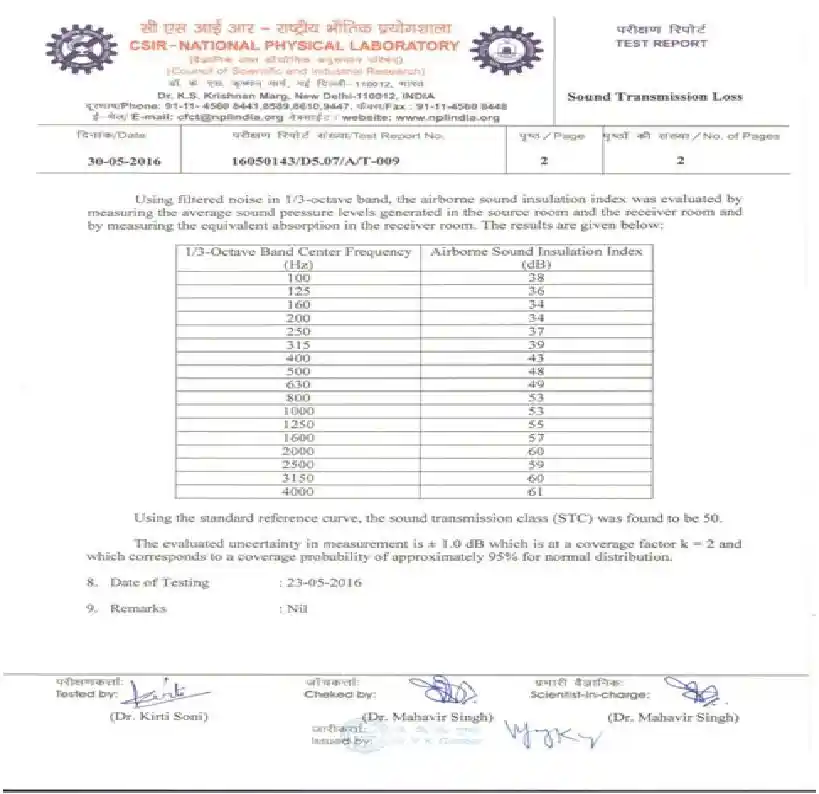
STC Test Reports
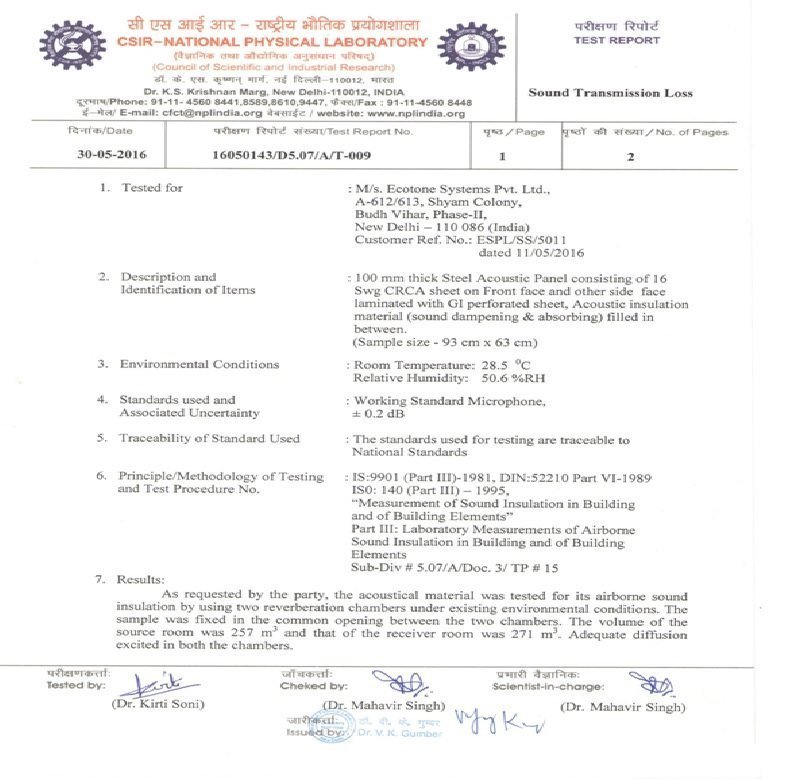
Every sound proof enclosure Ecotone delivers is backed by lab-tested STC and octave band transmission loss reports referenced against CSIR National Physical Laboratory (NPL) standards, available on request before you finalise an order. Ask for this report specifically, since a manufacturer’s brochure figure and an independently tested figure are not always the same number.
Technical Data Sheet
| Property | Value / Standard |
|---|---|
| Product | Sound Proof Enclosure / Industrial Sound Enclosure |
| Wall construction | Double-skin CRCA/GI with fire rated mineral wool core |
| STC rating | STC-40 to STC-60 |
| Frequency range tested | 63 Hz to 8 kHz, full octave band |
| Testing standard reference | CSIR National Physical Laboratory (NPL) acoustic testing |
| Build resistance | Water resistant, dust and humidity protected |
| Ventilation | Insulated ducts with acoustically treated louvers |
| Access | Vision panels, hinged or sliding acoustic doors |
| Finish | Epoxy or powder coating, custom colour |
| Manufacturer certification | ISO 9001:2015, 40+ years engineering experience |
| Customisation | Machine size, door position, cable entry, colour |
How Do Sound Proof Enclosures Actually Reduce Machine Noise?
Short answer: They combine an absorbing inner layer that converts sound energy to heat, a dense outer skin that blocks transmission, sealed joints that stop leaks, and tuned ventilation that lets air move without letting noise escape through the airflow path.
-
01
Absorption
Mineral wool or foam inside the panel dissipates sound energy through friction.
-
02
Blocking
A dense CRCA or GI outer skin reflects sound rather than transmitting it.
-
03
Sealing
Gaskets and acoustic caulking close every joint, since even small gaps leak disproportionate noise.
-
04
Ventilation
Insulated ducts and acoustic louvers allow airflow without a straight-line noise path.
Why One Sound Proof Enclosure Design Does Not Fit a Sewing Machine and a Hydraulic Power Pack
Most competing pages describe sound proof enclosures as a single product with one spec sheet. In practice, after specifying enclosures across garment units, fragrance plants, and heavy industrial sites, the design brief changes completely depending on the noise source, and treating them the same is the most common reason a delivered enclosure underperforms.
A sewing machine or cable machine produces mostly mid to high frequency noise with very little heat output, so the enclosure can be lighter, with smaller ventilation openings, and STC-40 range panels are usually sufficient. A hydraulic power pack or air compressor produces strong low frequency noise combined with real heat load from the motor and pump, and low frequency sound is physically harder to block because it needs mass and thickness, not just absorption foam, so these typically need STC-50 or higher panels with a properly sized forced ventilation path. This is exactly the pattern seen in a recent enclosure Ecotone built for a hydraulic power pack for Surabhi Fragrances in Jaipur, where the ventilation design had to be reworked around the pump’s actual heat curve, not a generic acoustic louver size, to hit the target noise reduction without heat buildup.
The Octave Band Trap: Why a Single STC Number Can Mislead Buyers
A vendor quoting “STC-50” without specifying the frequency range is giving you an incomplete picture. Genuine acoustic testing measures transmission loss across a full octave band, typically 63 Hz to 8 kHz, because a panel can perform very well at high frequencies and poorly at low frequencies, or vice versa, and a single averaged STC number hides this. A compressor or generator’s dominant noise energy sits in the lower octave bands, around 63 Hz to 250 Hz, which is the hardest range for any panel to attenuate. Before ordering, ask your sound proof enclosures manufacturer for the octave band transmission loss chart, not just the headline STC figure, especially if your machine is a compressor, generator, or turbine rather than a high-frequency source like a sewing machine.
Water Resistance and Fire Rating: The Spec Buyers Forget to Ask About
Noise reduction gets all the attention in enclosure conversations, but two specs quietly determine how long the enclosure actually lasts in Indian site conditions. First, water resistance matters for any enclosure installed outdoors or in a humid processing plant, since untreated infill material absorbs moisture over time, adds weight, and loses acoustic performance within a year or two. Second, fire rated infill is not optional for enclosures near electrical panels, hydraulic systems, or any heat-generating machine, since standard acoustic foam can be a fire risk in an enclosed, poorly ventilated space. A credible manufacturer will confirm both in writing, water resistant construction and fire rated core material, rather than only quoting the dB(A) reduction number.
Myth vs Reality
| Myth | Reality |
|---|---|
| Higher STC always means quieter site | Frequency match to your noise source matters more |
| All enclosures fit any machine size | Design changes with heat load and frequency |
| Foam infill is enough for any use case | Fire rated material is essential near heat sources |
| One vendor spec sheet tells the full story | Ask for octave band and lab test reports |
| Enclosures always block 100% of sound | Well-built units cut 25 to 50 dB(A), not silence |
Sound Proof Enclosures vs Basic Acoustic Covers: What Is the Real Difference?
A basic acoustic cover is usually a single-layer foam wrap or a fabricated metal box with no lab testing behind it. A true sound proof enclosure is engineered against a specific STC target, tested across an octave band frequency range, and built with fire rated, water resistant materials and calculated ventilation. The price difference reflects real engineering, not just material cost, and it is the reason a tested enclosure from a certified enclosure manufacturer in india consistently outperforms an untested fabricated box over a two to three year period.
How to Choose a Sound Proof Enclosures Manufacturer in India
Ask for an octave band test report referencing a recognised lab, not just a single STC number.
Confirm ventilation is sized for your machine's actual heat output, not a standard template size.
Check whether the infill is fire rated and the outer build is water resistant.
Verify manufacturer certification, ISO 9001:2015 and testing aligned with CSIR NPL standards.
Ask for examples of enclosures built for your exact machine type, compressor, hydraulic pack, or turbine.
Request photos or references from a completed project similar to your site.
Frequently Asked Questions
What is the difference between an acoustic enclosure and a sound proof enclosure?
None functionally. Both describe the same engineered, tested noise control structure.
Do sound proof enclosures reduce noise 100 percent?
No. Well-built enclosures typically cut noise by 25 to 50 dB(A).
Can a sound proof enclosure overheat a compressor?
Only with undersized ventilation. Correct louver sizing prevents heat buildup.
What material works best for a soundproof enclosure?
Mineral wool with a dense CRCA or GI outer skin performs best.
Are sound proof enclosures fireproof?
Fire rated infill reduces risk significantly, but confirm the rating with your manufacturer.
How is enclosure noise reduction actually tested?
Labs measure octave band transmission loss from 63 Hz to 8 kHz.
Can one enclosure design work for different machines?
No. Frequency and heat load differ by machine, changing the required design.
How long does a sound proof enclosure installation take?
Modular panel enclosures typically install within a few days on-site.
Do sound proof enclosures need maintenance?
Yes. Door seals and ventilation filters need periodic inspection and replacement.
Is a local enclosure manufacturer better than an importer?
Local manufacturers offer faster service, on-site testing, and easier customisation.
Get a Site-Specific Sound Proof Enclosure Quote
If your current enclosure isn't holding its rated noise reduction, or you're specifying one for a compressor, generator, hydraulic power pack, or production machine, Ecotone Systems designs and delivers ISO 9001:2015 certified sound proof enclosures tested to CSIR NPL standards, backed by real project data across Indian industries.
Trusted by India's Leading Brands
Hover to pause · Logos scroll continuously