Reverberation Chamber Manufacturer in India

Summary: A reverberation chamber is a highly reflective, shielded test room that uses rotating metal paddles, or stirrers, to create a statistically uniform field inside, either a diffuse sound field for acoustic testing or a uniform high-strength electromagnetic field for EMC immunity and emissions testing, in a fraction of the power a comparable anechoic chamber setup would require. This page is written for EMC test engineers, automotive and electronics acoustic labs, and defense and aerospace compliance teams in India who are specifying a reverberation chamber, comparing manufacturers, or trying to understand why a chamber’s usable frequency range and shielding performance actually matter.

Reverberation Chamber, reverberation chamber, EMC reverberation chamber, EMC test chamber, reverberation test chamber, EMC testing chamber, EMC measurement chamber, mode stirred reverberation chamber, mode tuned reverberation chamber, high field strength chamber, high field strength EMC chamber, EMC immunity testing, EMC measurement, EMC immunity test chamber, high field strength applications, very high field strength testing, high field EMC testing, low frequency EMC testing, wide frequency range, paddle system, EMC paddle system, reverberation chamber paddle system, IEC 61000-4-21, RVC-80, RVC-200, RVC-400, RVC-1000, reverberation chamber models, EMC compliance testing, EMC emissions testing, electrical product EMC testing, electronic product EMC testing, EMC certification testing, EMC compliance chamber, radiated immunity testing, EMC radiated immunity, HIRF testing, HIRF applications, MIL-STD-461 testing, DO-160 testing, RTCA DO-160 testing, Lowest Usable Frequency, LUF, EMC LUF, reverberation chamber LUF, 80 MHz reverberation chamber, 200 MHz reverberation chamber, 400 MHz reverberation chamber, 1000 MHz reverberation chamber, 18 GHz EMC chamber, 40 GHz EMC chamber, mode stir EMC chamber, stirrer system, paddle stirrer, tuner system, modular EMC chamber, custom EMC chamber, relocatable EMC chamber, turnkey EMC measurement system, EMC shielding, 100 dB shielding performance, EN 50147-1, EMC shielded doors, EMC antenna mounts, EMC dual ridge horn antenna
Acoustic Reverberation Chamber Guide

Is This Acoustic Reverberation Chamber Guide Right for You?

01

Who It's For

Electronics and electrical product manufacturers needing EMC compliance testing, defense and aerospace organisations needing HIRF and MIL-STD-461 or DO-160 testing, and automotive and audio device manufacturers needing acoustic reverberant field testing.


02

When to Use This Guide

Before finalising a reverberation chamber manufacturer, while comparing field strength and LUF claims across quotes, or when specifying a chamber for a specific standard such as IEC 61000-4-21, MIL-STD-461, or RTCA DO-160.

03

Proven Track Record

800+ acoustic enclosure projects delivered across power plants, manufacturing units, and processing facilities in India.

What Is a Reverberation Chamber?

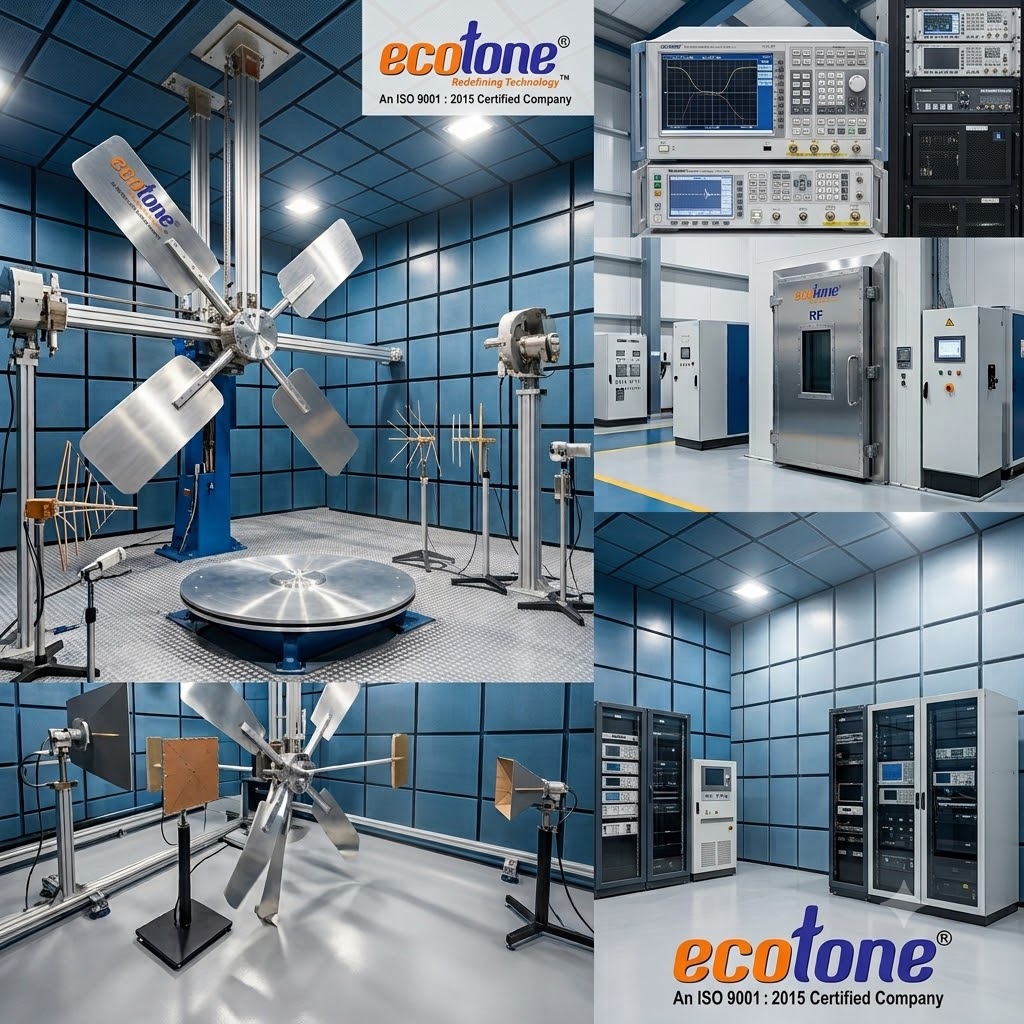
A reverberation chamber is a shielded, highly reflective room, unlike an anechoic chamber, which absorbs energy, a reverberation chamber is built to reflect it, using rotating paddles or stirrers that continuously change the room’s boundary conditions to build up a statistically uniform, high-intensity field throughout the test volume. Depending on the application, that field can be an acoustic diffuse sound field, used for headphone, audio device, and vehicle cabin acoustic testing, or a uniform electromagnetic field, used for EMC immunity and emissions testing under standards like IEC 61000-4-21. The chamber supports both mode-tuned testing, where the paddle steps and stops at discrete positions, and mode-stirred testing, where it rotates continuously through a sweep. If you needed the one-line definition, that’s it. The sections below cover what actually determines whether a reverberation chamber delivers valid, repeatable test data.

Why Indian Electronics, Automotive, and Defense Sectors Are Standardising on Reverberation Chamber Testing

EMC and acoustic reverberation chamber testing exists because product certification increasingly requires demonstrating performance under conditions no single anechoic setup can efficiently replicate. IEC 61000-4-21 defines the reverberation chamber test method for radiated EMC immunity and emissions testing, specifying how mode stirring generates a statistically uniform field and how a chamber’s lowest usable frequency must be established before it can be considered valid for a given test band.<sup>[1]</sup> Reverberation chambers are also central to defense and aerospace compliance work, supporting MIL-STD-461E/F/G and RTCA DO-160E/F/G testing, including high field strength applications such as DO-160 Category L, where chambers can reach field strengths in the thousands of V/m far more efficiently than an anechoic chamber and amplifier setup of comparable size. This guide explains what to check before committing to an EMC or acoustic reverberation chamber manufacturer.

Specifications, Benefits, Applications & Installation Process

Parameter Standard Specification
Chamber models RVC-80, RVC-200, RVC-400, RVC-1000
Frequency range 80 MHz up to 18 GHz or 40 GHz depending on model
Field strength capability Up to 7200 V/m (4 to 6 GHz range)
Shielding performance Up to 100 dB attenuation
Compliance standards IEC 61000-4-21, MIL-STD-461E/F/G, RTCA DO-160E/F/G
Stirring modes Mode-tuned (stepped) and mode-stirred (continuous)
Shielding test reference EN 50147-1
Benefit Impact
High field-to-power efficiency Reaches high field strength using far less amplifier power
Large test volume Accommodates large or complex assemblies easily
Dual-use capability Supports both acoustic and EMC test disciplines
Standards compliance Aligns with IEC 61000-4-21, MIL-STD-461, DO-160
Repeatable measurements Statistically uniform field improves test consistency
Faster throughput Continuous paddle rotation shortens settling times
Lower testing cost More cost-effective than large-scale anechoic setups
Application Typical Use
EMC radiated immunity testing Electronics and electrical product certification
EMC radiated emissions testing Product compliance and pre-compliance testing
HIRF and high field strength testing Aerospace and defense equipment
MIL-STD-461 and DO-160 testing Military and aerospace product qualification
Headphone and audio device testing Sound clarity and noise cancellation evaluation
Vehicle cabin acoustic testing In-cabin noise and sound behaviour analysis
Engine and powertrain noise evaluation Automotive acoustic development
Step Action
1. Requirement study Confirm target frequency range, field strength, and LUF
2. Chamber sizing Select RVC model based on required lowest usable frequency
3. Shielded shell fabrication Chamber built and shielded to target attenuation performance
4. Paddle and stirrer installation Mode-stirred or mode-tuned paddle system fitted
5. Antenna and accessory fitting Horn antennas, mounts, and test bench installed
6. Controller integration Optional EMC chamber controller configured
7. Qualification testing Field uniformity and shielding verified against standard

Lowest Usable Frequency: The Reverberation Chamber Equivalent of Cut-off Frequency

Every reverberation chamber has a Lowest Usable Frequency, or LUF, the lowest frequency at which the chamber contains enough resonant modes to produce a statistically valid, uniform field as the paddle rotates. Unlike an anechoic chamber, where the limiting factor is wedge depth relative to wavelength, a reverberation chamber’s LUF is governed by chamber volume and mode density, larger internal volume supports more simultaneous resonant modes at a given frequency, which is why chamber model naming often tracks directly to LUF. An RVC-80 is sized to deliver a usable field down to 80 MHz, while an RVC-1000 is a physically smaller chamber whose LUF sits around 1000 MHz, not because it’s a lesser chamber, but because a smaller volume simply cannot support sufficient mode density at lower frequencies. Specifying a chamber model without checking whether its LUF actually covers your required test frequency is the single most common sizing mistake in reverberation chamber procurement.

Mode-Stirred vs Mode-Tuned: Why the Difference Isn't Just Terminology

Mode-tuned and mode-stirred are often used almost interchangeably in casual conversation, but they describe genuinely different test procedures with different implications for throughput and applicable standards. In mode-tuned operation, the paddle steps to a series of discrete positions and pauses at each one while a measurement is taken, building a data set position by position. In mode-stirred operation, the paddle rotates continuously through a full sweep while measurements are taken throughout the rotation, which shortens settling time and improves throughput considerably for broadband immunity testing. IEC 61000-4-21 accommodates both approaches, but specific standards, including some MIL-STD-461 and DO-160 test procedures, may call for one method over the other depending on the test being performed. A chamber and controller combination that only supports one stirring mode may be unsuitable for a lab that needs to run both EMC immunity sweeps and narrowband, standard-specific tests.

Why Reverberation Chambers Beat Anechoic Chambers for High Field Strength Testing (But Not for Every Test)

A reverberation chamber’s reflective walls are precisely why it can reach very high field strengths, up to 7200 V/m in the 4 to 6 GHz range in a well-designed chamber, using dramatically less amplifier power than an anechoic chamber would need for the same field strength, since energy isn’t absorbed by the walls but builds up through repeated reflection. This field-to-power efficiency is exactly why reverberation chambers are the practical choice for HIRF and high field strength immunity testing under standards like DO-160 Category L, where anechoic testing at equivalent field strength would require prohibitively large amplifiers. The trade-off is that a reverberation chamber cannot provide a directional, polarization-specific field the way an anechoic chamber with a positioned antenna can, so radiated emissions testing that requires identifying the direction and polarization of an emission source is generally better suited to an anechoic setup. Choosing between the two isn’t about which is “better,” it’s about matching the chamber type to whether your test needs field intensity and efficiency, or directional and polarization resolution.

Technical Data Sheet

Property Value / Standard
Product Reverberation Chamber (Acoustic / EMC)
Chamber models RVC-80, RVC-200, RVC-400, RVC-1000
Governing EMC standard IEC 61000-4-21
Additional standards MIL-STD-461E/F/G, RTCA DO-160E/F/G
Shielding test standard EN 50147-1
Field strength Up to 7200 V/m, 4 to 6 GHz range
Shielding performance Up to 100 dB
Stirring system Paddle-based, mode-tuned or mode-stirred
Antenna options Dual ridge horn antennas, 200 MHz to 2000 MHz range
Construction Modular, relocatable, or custom-built options
Customisation Frequency range, field strength, LUF, chamber volume

How Do Reverberation Chambers Work?

Short answer: Reflective internal surfaces and rotating paddles continuously change the chamber’s boundary conditions, building up a statistically uniform acoustic or electromagnetic field throughout the test volume as the paddle sweeps through its rotation.

  • Reflective surfaces: unlike absorptive anechoic walls, reverberation chamber walls are designed to reflect energy back into the room.
  • Paddle or stirrer rotation: continuously changing boundary conditions average out field variations across the chamber.
  • Mode density: enough resonant modes must be excited at the test frequency for the field to be considered statistically uniform.
  • Settling time: continuous paddle rotation in mode-stirred testing shortens the time needed between measurements.

How to Choose a Reverberation Chamber Manufacturer

  • Confirm the chamber's Lowest Usable Frequency actually covers your required test frequency range, not just the chamber's headline model number.
  • Ask whether the chamber and controller support both mode-tuned and mode-stirred operation if your test programme needs both.
  • Verify shielding performance against EN 50147-1 or an equivalent recognised measurement procedure.
  • Check compliance coverage for your specific standard, IEC 61000-4-21, MIL-STD-461, or RTCA DO-160.
  • Ask whether the chamber design suits both EMC and acoustic reverberant testing if your lab needs dual-use capability.
  • Request field uniformity and shielding qualification data, not just a theoretical specification.

Myth vs Reality

Myth Reality
A bigger chamber model number means better performance Model number often reflects usable frequency, not quality
Mode-stirred and mode-tuned testing are the same thing They use different paddle motion and measurement procedures
Reverberation chambers replace anechoic chambers entirely Each suits different tests, field intensity versus direction
Any reverberation chamber works at any frequency LUF, set by chamber volume, limits the usable range
High shielding rating alone guarantees valid EMC data Field uniformity and LUF must also be verified

Frequently Asked Questions

Reverberation chambers reflect energy to build a uniform field, anechoic chambers absorb it.
The lowest frequency at which the chamber has enough modes for valid testing.
Mode-tuned steps and pauses, mode-stirred rotates continuously during measurement.
Yes, the same reflective, mode-stirred principle applies to both disciplines.
IEC 61000-4-21 is the primary standard, alongside MIL-STD-461 and DO-160.
They reach high field strength with far less amplifier power than anechoic setups.
No, anechoic chambers with positioned antennas suit directional testing better.
Against standards like EN 50147-1, typically rated up to 100 dB attenuation.
It generally corresponds to the chamber's lowest usable frequency in MHz.
Modular and relocatable designs are available alongside permanent installations.
SITE-SPECIFIC REVERBERATION CHAMBER SOLUTIONS

Get a Site-Specific Reverberation Chamber Quote

Whether you need an EMC reverberation chamber for IEC 61000-4-21, MIL-STD-461, or DO-160 compliance testing, or an acoustic reverberation chamber for audio device and vehicle cabin evaluation, Ecotone Systems designs and delivers reverberation chambers sized against your actual required Lowest Usable Frequency and field strength, not just a model number.

✓ IEC 61000-4-21
✓ MIL-STD-461 / DO-160
✓ Field Strength Verification
✓ Site-Specific Design
Talk to Our Test Chamber Engineering Team →
OR CALL OUR TEAM
+91 98103 19823 | +91 98913 20678
Our Clients

Trusted by India's Leading Brands

Hover to pause · Logos scroll continuously

500+
Projects Completed
40+
Years Experience
200+
Happy Clients
15+
States Covered
Havells
Brandworks
ATS
Allone Infra
Nidec
Hero Cycles
Oerlikon Balzers
Mahindra
Jaguar
HAL
Hitachi
Blue Star
Google
Zuari Cement
IIT Kanpur
Havells
Brandworks
ATS
Allone Infra
Nidec
Hero Cycles
Oerlikon Balzers
Mahindra
Jaguar
HAL
Hitachi
Blue Star
Google
Zuari Cement
IIT Kanpur
Client Logo
Client Logo
DRDO
Logitech
BMM
MP Government
Client Logo
NHAI
Client Logo
Client Logo
Client Logo
Client Logo
Client Logo
Client Logo
Client Logo
DRDO
Logitech
BMM
MP Government
Client Logo
NHAI
Client Logo
Client Logo
Client Logo
Client Logo
Client Logo