
DG and Turbine Acoustic Enclosure Manufacturer in India
Summary: A DG and turbine acoustic enclosure is an engineered, ventilated structure built around diesel generators, gas turbines, or steam turbines to cut noise emission to compliant levels, typically 75 to 85 dB(A) at one metre, without restricting the airflow the machine needs to stay cool. This page is written for power plant engineers, DG set operators, EPC contractors, and EHS teams in India who are specifying, comparing, or troubleshooting a turbine or generator acoustic enclosure.
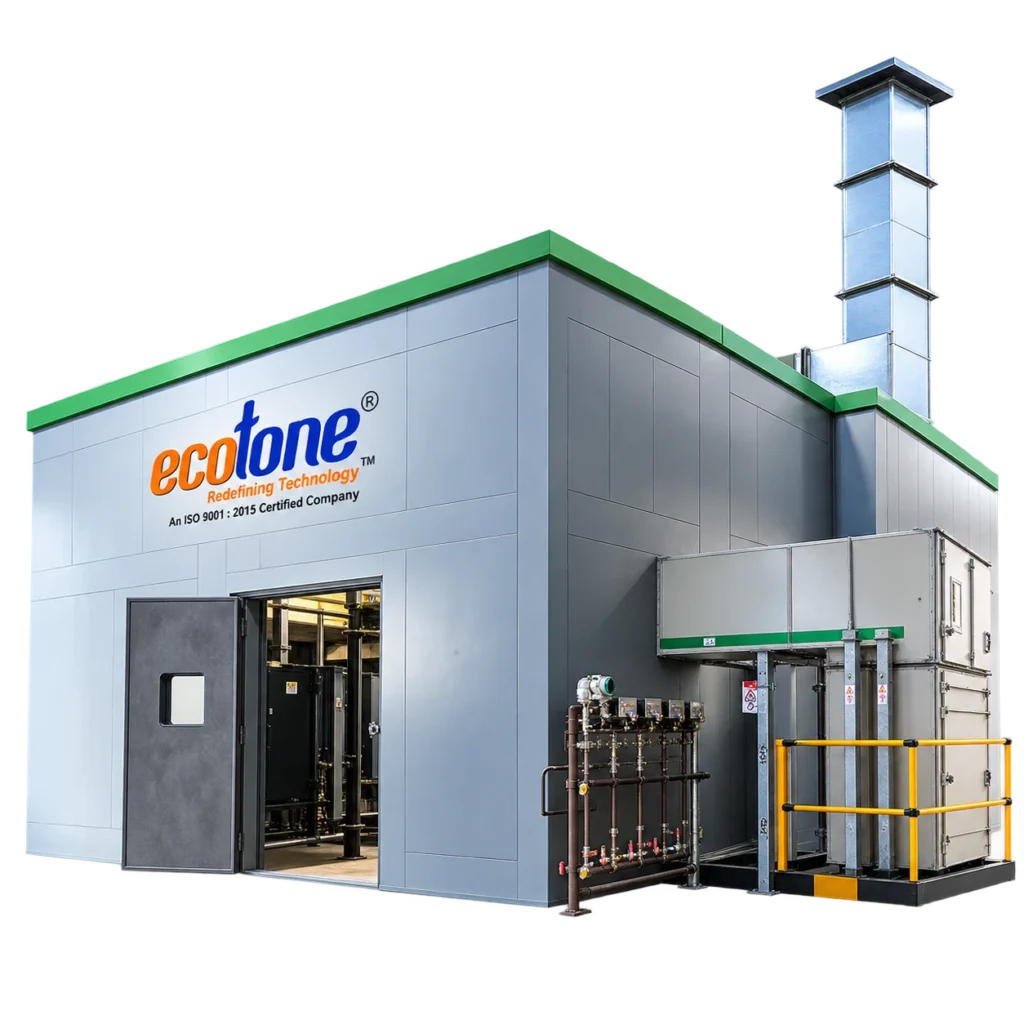
Is This Turbine Acoustic Enclosure Guide Right for You?
Who It's For
Power plants, combined-cycle stations, refineries, real estate and hospital backup power installations, and industrial facilities running gas turbines, steam turbines, or diesel generator sets.
When to Use This Guide
Before finalising a turbine acoustic enclosure manufacturer in India, when comparing ventilation designs across quotes, or when an existing DG or turbine enclosure is overheating or underperforming on noise.
What This Guide Helps You Check
Evaluate enclosure design, ventilation performance, noise-control requirements, equipment accessibility, heat management, and the engineering capability of a potential turbine acoustic enclosure manufacturer.
What Is a DG and Turbine Acoustic Enclosure?
A DG and turbine acoustic enclosure is a purpose-built, sealed structure that surrounds a diesel generator, gas turbine, or steam turbine to contain and reduce the noise it produces during operation. It works through three combined mechanisms: sound absorbing material lining the interior walls that dampens sound energy, a dense outer structure of steel or composite panels that blocks sound transmission, and an acoustically treated ventilation system, using louvers, silencers, and attenuators, that removes heat without opening a straight-line path for noise to escape. Turbines generate high-frequency, high-intensity noise from combustion and high-speed rotation, sometimes worsened by a magnetostriction effect in the core components, while diesel generators produce lower-frequency, more impulsive noise from reciprocating combustion. If you needed the one-sentence version, that’s it. The sections below cover what actually separates a working enclosure from one that fails on-site.
Why Power Plants Are Standardising on Certified Turbine and DG Acoustic Enclosure Manufacturers
Noise compliance for rotating power equipment in India is enforced at two levels: workplace exposure and boundary emission. OSHA-aligned occupational exposure guidance flags continuous noise above 85 dB(A) as a hearing hazard requiring engineering controls, not PPE alone, while India’s noise pollution control framework under CPCB caps DG set and industrial-zone emissions in the 70 to 75 dB(A) range depending on capacity and zone. Turbine installations commonly work to a benchmark of not exceeding 85 dB(A) at one metre from the enclosure surface, a figure widely referenced across gas turbine noise control specifications. Meeting these numbers on paper is easy. Meeting them on-site, without overheating the turbine or restricting maintenance access, is where most fabricated (non-tested) enclosures fail. This guide is built around that gap.
Specifications, Benefits, Applications & Installation Process
| Parameter | Standard Specification |
|---|---|
| Construction material | Mild carbon steel, galvanized steel, or SS 304/316 |
| Panel type | Collapsible acoustic wall and roof panels on bolted frame |
| Noise reduction | 25 to 50 dB(A) depending on enclosure design |
| Compliance benchmark | Up to 85 dB(A) at 1 metre for turbine enclosures |
| Ventilation | Acoustic louvers, inlet/exhaust silencers, attenuators |
| Door type | Gasketed hinge or sliding acoustic doors with vision panel |
| Optional system | Integrated Fire and Gas (F&G) protection for gas turbines |
| Parameter | Standard Specification |
|---|---|
| Regulatory compliance | Meets CPCB and OSHA-aligned exposure limits |
| Worker hearing protection | Cuts exposure below the 85 dB(A) hazard threshold |
| Cooling preserved | Tuned ventilation prevents turbine or DG overheating |
| Fire and gas safety | F&G protection detects leaks before ignition risk |
| Equipment protection | Shields against rain, dust, and corrosion |
| Maintenance access | Gasketed doors and cutouts allow service without noise leaks |
| Community relations | Reduces boundary noise complaints near plants |
| Application | Typical Industry |
|---|---|
| Gas turbine enclosure | Power plants, combined-cycle stations, refineries |
| Steam turbine enclosure | Thermal power and process industries |
| DG set acoustic enclosure | Backup power for hospitals, real estate, industry |
| Industrial generator enclosure | Manufacturing plants, data centres |
| Compressor and pump enclosures | Testing facilities, laboratories |
| HVAC noise control enclosures | Commercial and industrial buildings |
| Power press and blower enclosures | Auto components, metal fabrication |
| Step | Action |
|---|---|
| 1. Site survey | Measure ambient dB(A), machine heat load, access needs |
| 2. Ventilation design | Size silencers and louvers to actual turbine or DG airflow |
| 3. Fabrication | Panels pressed, infilled, and coated at factory |
| 4. F&G system integration | Flame/gas detectors and control panel fitted where required |
| 5. Foundation prep | Base leveling, cable and cutout routing on site |
| 6. Panel erection | Bolted collapsible panel assembly with gasket sealing |
| 7. Test and handover | On-site dB(A) verification and ventilation performance check |
Technical Data Sheet
| Property | Value / Standard |
|---|---|
| Product | DG and Turbine Acoustic Enclosure |
| Construction | Mild carbon steel, galvanized steel, or SS 304/316 |
| Panel design | Collapsible acoustic wall and roof panels, bolted structure |
| Noise reduction target | 25 to 50 dB(A), up to 85 dB(A) at 1m for turbines |
| Ventilation components | Acoustic louvers, inlet silencer, exhaust silencer, attenuators |
| Fire and gas protection | IR3 flame detectors, infrared gas detectors, inert gas suppression |
| F&G panel rating | IP55-rated control cabinet, Zone 2 hazardous area rated |
| Door hardware | Gasketed hinge doors, spring-loaded lock, SS hinges |
| Corrosion protection | Zinc-passivated hardware, 2-coat primer plus automotive paint |
| Illumination | 300 LUX internal lighting with switchboard wiring |
| Compliance references | CPCB norms, ISO 14001, OSHA-aligned exposure limits |
How Does Turbine Enclosure Ventilation Work Without Undoing the Noise Reduction?
Short answer: Gas turbine enclosure ventilation uses acoustically lined ductwork, inlet and exhaust silencers, and baffled attenuators so cooling air can enter and hot air can exit without creating a direct, unlined path for noise to escape.
Inlet Silencer
Draws fresh air in through a baffled path that blocks line-of-sight noise transmission.
Exhaust Silencer
Removes hot air from inside the enclosure through the same acoustically treated principle.
Acoustic Louvers
Angled, lined blades allow airflow while reflecting sound back inside.
Ventilation Exhaust Cracker
Manages pressure and airflow balance so the turbine's cooling requirement is met without over-venting noise.
The Real Difference Between a DG Acoustic Enclosure and a Turbine Acoustic Enclosure
Most content treats “generator enclosure” and “turbine enclosure” as interchangeable, and that assumption causes real design mistakes. A diesel generator is a reciprocating engine, producing lower-frequency, pulsing noise tied to piston and combustion cycles, along with mechanical vibration transmitted through the base frame. A gas or steam turbine is a high-speed rotational machine, producing higher-frequency, more continuous noise from combustion and blade rotation, and in some designs, a magnetostriction effect inside electromagnetic components adds a distinct tonal noise component that a generic absorption panel does not handle well.
This matters practically because a DG acoustic enclosure prioritises vibration isolation at the base and impulsive noise damping, while a turbine acoustic enclosure prioritises continuous high-frequency absorption and airflow volume, since turbines typically reject far more heat per unit time than a similarly rated DG set. A manufacturer quoting the same panel specification for both, without adjusting for this frequency and thermal difference, is not giving you an engineered solution, just a resized box.
Why Fire and Gas Protection Is Standard on Gas Turbine Enclosures But Optional on DG Enclosures
Gas turbines run on combustible fuel gas piped directly into the enclosure, which creates a leak and ignition risk that a diesel generator, running on liquid fuel with a different flashpoint profile, does not carry in the same way. This is why gas turbine acoustic enclosures typically include an integrated Fire and Gas (F&G) protection system: IR3 flame detectors, infrared gas detectors, an inert gas-based suppression system, and audible/visual alarms tied into the plant’s main control system, all housed in an IP55-rated panel and rated for Zone 2 hazardous areas. A DG acoustic enclosure, by contrast, focuses more on rainwater protection hoods, gasketed doors, and zinc-passivated hardware to prevent corrosion and noise leakage, since its fire risk profile is different.
If a vendor quotes a “standard enclosure” for a gas turbine without asking whether F&G protection is required, that is a gap worth raising before signing off, not after commissioning.
The Ventilation Sizing Mistake That Overheats More Turbine Enclosures Than Any Other Design Flaw
The most common failure in field-reported turbine and DG enclosure problems is not the acoustic panel, it is a ventilation system sized off a generic template rather than the machine’s actual heat rejection curve. Turbines and DG sets reject different volumes of heat depending on load factor, ambient temperature, and altitude, and a silencer or louver sized for a smaller unit, or for average rather than peak load, will cause the enclosure’s internal temperature to climb during high-load or high-ambient conditions, triggering thermal shutdowns that get blamed on the machine rather than the enclosure. A properly engineered DG turbine enclosure ventilation design calculates airflow (CFM) against the specific machine’s rated heat rejection at full load and peak ambient temperature, not a one-size assumption carried over from the last project.
Myth vs Reality
| Myth | Reality |
|---|---|
| DG and turbine enclosures use the same design | Frequency and heat load differ, requiring different designs |
| Enclosures always reduce cooling efficiency | Correct ventilation sizing preserves full cooling performance |
| Fire and gas protection is needed for every enclosure | Mainly required for gas-fuelled turbines, not diesel gensets |
| Thicker panels always mean quieter operation | Ventilation and sealing quality often matter more |
| One enclosure spec fits any turbine size | Design changes with turbine capacity and heat rejection |
Sound Proof Enclosure for Generator: Are All These Terms the Same Product?
Yes. Whether you search for it as a generator acoustic enclosure, generator sound enclosure, sound attenuating enclosure, sound attenuated enclosures generator, generator sound attenuated enclosure, generator sound proof enclosure, generator noise enclosure, sound dampening generator enclosure, noise enclosure for generator, industrial generator enclosure, or sound deadening generator enclosure, all of these describe the same category of engineered, tested structure built to reduce diesel generator noise. The terminology varies by region and industry habit, tender documents often use “sound attenuating enclosure,” while general search traffic uses “soundproof enclosure” or “generator noise enclosure,” but the underlying product, specification, and testing requirements are identical. A credible acoustic enclosure for dg set will meet the same CPCB and ISO 14001 benchmarks regardless of which term is used to search for it.
Common Features Built Into DG Acoustic Enclosures
Hinge-type acoustic doors, gasketed to block noise leakage at the gap
Spring-loaded lock, openable from both inside and outside
Rainwater protection hood over the fresh air inlet acoustic louvers
Internal electrical wiring, switchboard, and lighting maintaining 300 LUX
Zinc-passivated hardware with stainless steel door hinges to prevent rusting
Panel cutouts for pipe, cable entry, or project-specific requirements
Two coats of primer plus automotive-grade paint in the client's chosen shade
How to Choose a DG and Turbine Acoustic Enclosure Manufacturer in India
- Ask whether the ventilation design is calculated against your machine’s actual peak heat rejection, not a standard template.
- For gas turbines, confirm whether Fire and Gas protection is included or optional, and to what hazardous area rating.
- Check construction material options, mild steel, galvanized steel, or SS 304/316, against your site’s corrosion exposure.
- Request an on-site dB(A) test report, not only a catalogue noise reduction figure.
- Ask for examples of enclosures built for your exact machine type and capacity range.
- Confirm compliance references: CPCB norms, ISO 14001, and OSHA-aligned exposure guidance.
Frequently Asked Questions
+ Why is a turbine acoustic enclosure needed?
+ How effective is a turbine acoustic enclosure in reducing noise?
+ Does the enclosure affect turbine cooling or ventilation?
+ Are turbine acoustic enclosures easy to maintain?
+ What is the difference between a DG enclosure and a turbine enclosure?
+ Do gas turbine enclosures need fire and gas detection systems?
+ Can a sound proof enclosure for generator overheat the DG set?
+ What material is best for an industrial generator enclosure?
+ How much noise reduction is required for DG set compliance in India?
+ Is a modular turbine enclosure design available?
Get a Site-Specific DG or Turbine Acoustic Enclosure Quote
Whether you're specifying a gas turbine enclosure with integrated fire and gas protection, or a DG acoustic enclosure for a backup power installation, Ecotone Systems designs and delivers CPCB and ISO 14001-compliant turbine and generator acoustic enclosures across India, engineered against your machine's actual heat load and noise profile, not a generic template.
Trusted by India's Leading Brands
Hover to pause · Logos scroll continuously